
Contributor: Don’t count on regime change to stabilize Venezuela
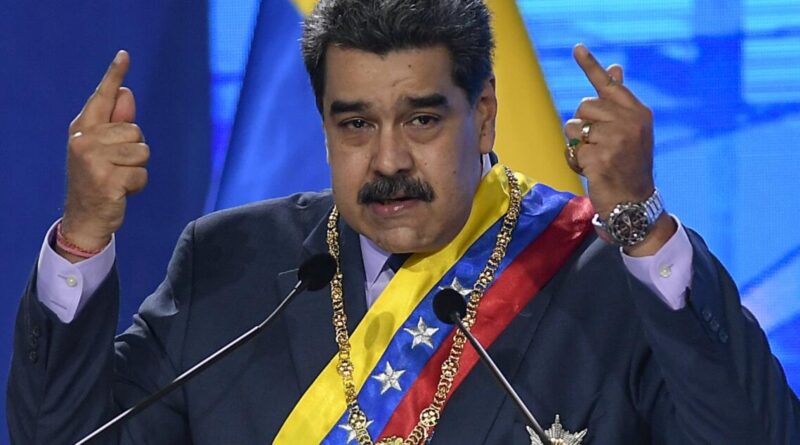
As the USS Gerald Ford aircraft carrier sails to the Caribbean, the U.S. military continues striking drug-carrying boats off the Venezuelan coast and the Trump administration debates what to do about Venezuelan dictator Nicolás Maduro, one thing seems certain: Venezuela and the western hemisphere would all be better off if Maduro packed his bags and spent his remaining years in exile.
This is certainly what Venezuelan opposition leader María Corina Machado is working toward. This year’s Nobel Prize laureate has spent much of her time recently in the U.S. lobbying policymakers to squeeze Maduro into vacating power. Constantly at risk of detention in her own country, Machado is granting interviews and dialing into conferences to advocate for regime change. Her talking points are clearly tailored for the Trump administration: Maduro is the head of a drug cartel that is poisoning Americans; his dictatorship rests on weak pillars; and the forces of democracy inside Venezuela are fully prepared to seize the mantle once Maduro is gone. “We are ready to take over government,” Machado told Bloomberg News in an October interview.
But as the old saying goes, if it sounds too good to be true, it probably is. While there’s no disputing that Maduro is a despot and a fraud who steals elections, U.S. policymakers can’t simply take what Machado is saying for granted. Washington learned this the hard way in the lead-up to the war in Iraq, when an opposition leader named Ahmed Chalabi sold U.S. policymakers a bill of goods about how painless rebuilding a post-Saddam Hussein Iraq would be. We all know how the story turned out — the United States stumbled into an occupation that sucked up U.S. resources, unleashed unpredicted regional consequences and proved more difficult than its proponents originally claimed.
To be fair, Machado is no Chalabi. The latter was a fraudster; the former is the head of an opposition movement whose candidate, Edmundo González Urrutia, won two-thirds of the vote during the 2024 Venezuelan presidential election (Maduro claimed victory anyway and forced González into exile). But just because her motives are good doesn’t mean we shouldn’t question her assertions.
Would regime change in Caracas produce the Western-style democracy Machado and her supporters anticipate? None of us can rule it out. But the Trump administration can’t bank on this as the outcome of a post-Maduro future. Other scenarios are just as likely, if not more so — and some of them could lead to greater violence for Venezuelans and more problems for U.S. policy in Latin America.
The big problem with regime change is you can never be entirely sure what will happen after the incumbent leader is removed. Such operations are by their very nature dangerous and destabilizing; political orders are deliberately shattered, the haves become have-nots, and constituencies used to holding the reins of power suddenly find themselves as outsiders. When Hussein was deposed in Iraq, the military officers, Ba’ath Party loyalists and regime-tied sycophants who ruled the roost for nearly a quarter-century were forced to make do with an entirely new situation. The Sunni-dominated structure was overturned, and members of the Shia majority, previously oppressed, were now eagerly taking their place at the top of the system. This, combined with the U.S. decision to bar anyone associated with the old regime from serving in state positions, fed the ingredients for a large-scale insurgency that challenged the new government, precipitated a civil war and killed tens of thousands of Iraqis.
Regime change can also create total absences of authority, as it did in Libya after the 2011 U.S.-NATO intervention there. Much like Maduro today, Moammar Kadafi was a reviled figure whose demise was supposed to pave the way for a democratic utopia in North Africa. The reality was anything but. Instead, Kadafi’s removal sparked conflict between Libya’s major tribal alliances, competing governments and the proliferation of terrorist groups in a country just south of the European Union. Fifteen years later, Libya remains a basket case of militias, warlords and weak institutions.
Unlike Iraq and Libya, Venezuela has experience in democratic governance. It held relatively free and fair elections in the past and doesn’t suffer from the types of sectarian rifts associated with states in the Middle East.
Still, this is cold comfort for those expecting a democratic transition. Indeed, for such a transition to be successful, the Venezuelan army would have to be on board with it, either by sitting on the sidelines as Maduro’s regime collapses, actively arresting Maduro and his top associates, or agreeing to switch its support to the new authorities. But again, this is a tall order, particularly for an army whose leadership is a core facet of the Maduro regime’s survival, has grown used to making obscene amounts of money from illegal activity under the table and whose members are implicated in human rights abuses. The very same elites who profited handsomely from the old system would have to cooperate with the new one. This doesn’t appear likely, especially if their piece of the pie will shrink the moment Maduro leaves.
Finally, while regime change might sound like a good remedy to the problem that is Venezuela, it might just compound the difficulties over time. Although Maduro’s regime’s remit is already limited, its complete dissolution could usher in a free-for-all between elements of the former government, drug trafficking organizations and established armed groups like the Colombian National Liberation Army, which have long treated Venezuela as a base of operations. Any post-Maduro government would have difficulty managing all of this at the same time it attempts to restructure the Venezuelan economy and rebuild its institutions. The Trump administration would then be facing the prospect of Venezuela serving as an even bigger source of drugs and migration, the very outcome the White House is working to prevent.
In the end, María Corina Machado could prove to be right. But she is selling a best-case assumption. The U.S. shouldn’t buy it. Democracy after Maduro is possible but is hardly the only possible result — and it’s certainly not the most likely.
Daniel R. DePetris is a fellow at Defense Priorities.
More to Read
Insights
L.A. Times Insights delivers AI-generated analysis on Voices content to offer all points of view. Insights does not appear on any news articles.
Viewpoint
This article generally aligns with a Center point of view. Learn more about this AI-generated analysis
Perspectives
The following AI-generated content is powered by Perplexity. The Los Angeles Times editorial staff does not create or edit the content.
Ideas expressed in the piece
The author argues that while Maduro is unquestionably a despot and electoral fraudster, U.S. policymakers cannot rely on the optimistic assessments of Venezuelan opposition leaders regarding post-regime change outcomes. Drawing parallels to the 2003 Iraq invasion, the author warns that regime change operations are inherently unpredictable and often produce unintended consequences far worse than the initial problem they aim to solve. The author contends that regime change in Venezuela could fragment political authority, as occurred in Libya after 2011, transforming the country into a haven for drug trafficking organizations and armed groups rather than a functioning democracy. A critical obstacle to democratic transition, the author maintains, is the Venezuelan military leadership’s deep entanglement with the Maduro regime through corruption and human rights abuses, making military cooperation with a successor government unlikely. The author concludes that while democratic transition after Maduro remains theoretically possible, assuming it represents the most likely outcome would be reckless policymaking based on best-case scenarios rather than realistic assessments of regional instability risks.
Different views on the topic
Opposition figures in Venezuela argue that they have exhausted peaceful alternatives and see external pressure as necessary for democratic change[2]. The Venezuelan opposition leadership maintains that after “multiple rounds of negotiations, protests, nonviolent methods of struggle, pressure from the international community, and participation in elections,” stronger measures are justified given the regime’s systematic repression and electoral fraud[2]. Analysts emphasize that sustainable solutions to Venezuela’s crisis require international support for democracy and human rights programs rather than disengagement[2]. Additionally, some policy experts argue that Venezuela’s resource curse is remediable through proper governance mechanisms, including transparent management of oil revenues and investments in infrastructure and education, suggesting that a government committed to institutional reform could chart a different path than the Maduro regime has followed[1]. These perspectives contend that continued support for democratic institutions and international pressure through legal channels represent viable alternatives to prolonged accommodation of authoritarian rule.